30 Years of the European Flag
 + Add to collection In collection ★ Wanted
 At a glance
| Country | Belgium |
|---|---|
| Year | 2015 |
| Issue date | 18 November 2015 |
| Coin type | Commemorative coin |
| Mintage | 412.500 (5.000 / 7.500) |
| Catalogue number | BE-15 G2 |
| Designer | Georgios Stamatopoulos |
| Rarity | €€€€€ what does this mean? |
| Edge lettering |  |
| Market value (approx.) | 4 € · guide price, uncirculated Unlock · for members |
Coin description
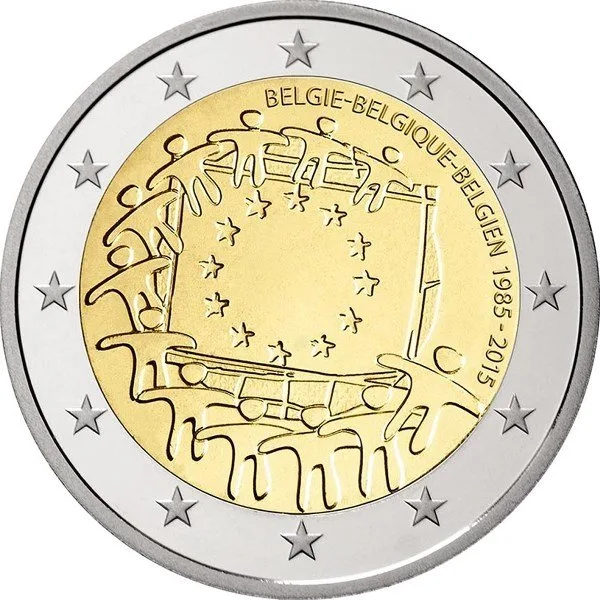
The EU flag as a symbol bringing peoples and cultures together around shared ideals for a better future. Twelve stars take on human form, welcoming the birth of a new Europe. Along the upper right of the inner ring, the issuing state in three languages — 'BELGIE-BELGIQUE-BELGIEN' — and the dates '1985–2015'. The mint director's mark and the mintmark (the helmeted head of Archangel Michael) appear to the right, between the flag and the dates. The designer's initials (Georgios Stamatopoulos) are at the lower right.
Note on the coin
Fourth joint issue of the European Union. All 19 eurozone states issued a coin with the same design on different dates. The coins differ only in the legend, which appears in the respective national language.
Further information on the topic
The European flag, with its twelve gold stars on a blue background, was designed by the Council of Europe in 1955 and officially adopted by the European Community in 1986. From the outset, the number twelve did not represent the number of members but stood as a symbol of completeness and unity — a concept rooted across European cultures and traditions. The design was chiefly developed by Arsène Heitz and Paul Lévy, and the Council of Europe in Strasbourg adopted it as a shared emblem for European institutions. In 1985, exactly 30 years before this issue, the heads of state and government of the European Community declared the flag their official symbol — a step that made Europe's growing political integration visible to the outside world.
Belgium is one of the founding members of European integration: as a signatory of the Treaties of Rome in 1957, the country was part of the project from the start, one that began with the Coal and Steel Community and gradually grew into a political and economic union. Brussels developed into the administrative centre of the European institutions, a fact that still shapes Belgium's close ties to the EU's history today. The joint issue by all euro states in 2015 to mark the 30th anniversary of the European flag made this historical dimension visible: for the first time, all member states issued a commemorative coin with an identical design — a unique event in the history of the euro that symbolically underscored the shared identity of the eurozone.
Official announcement (EU Official Journal): ABl. C 327 vom 3.10.2015, S. 5 (2015/C 327/06)
Technical data
| Face value | 2 euro |
|---|---|
| Material | Bimetallic – outer ring: cupronickel; centre: three layers (nickel-brass / nickel / nickel-brass) |
| Weight | 8.5 g |
| Diameter | 25.75 mm |
| Thickness | 2.20 mm |