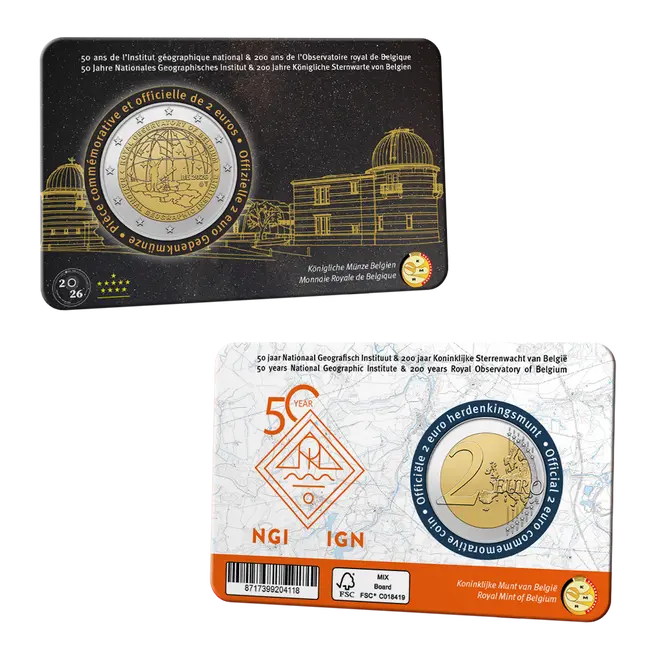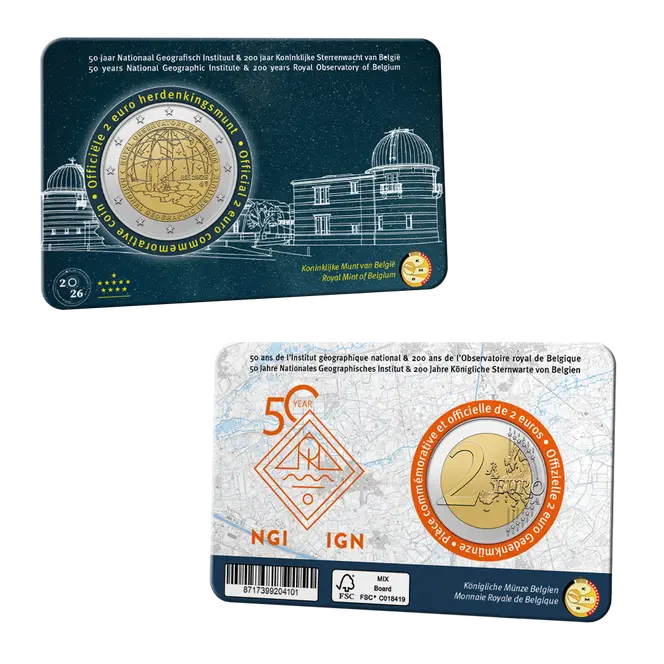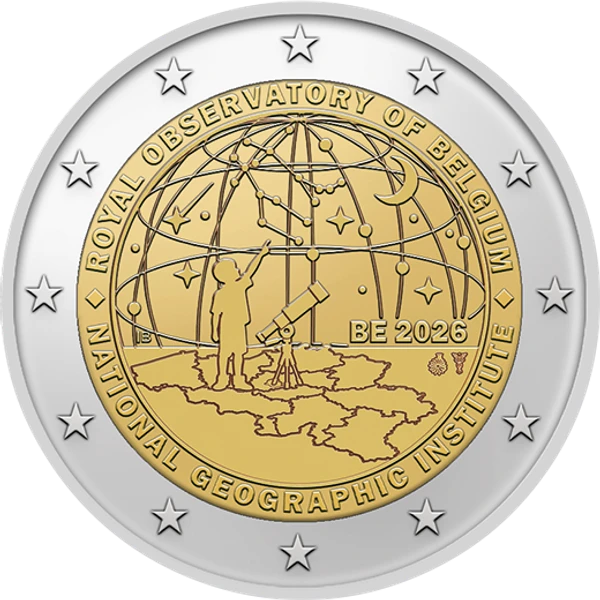
The design of Belgium's second €2 commemorative coin for 2026 was unveiled today, and the coin was officially issued at the same time. The Royal Belgian Mint presented the design, which honours a double scientific anniversary: "200 Years of the Royal Observatory of Belgium and 50 Years of the National Geographic Institute."
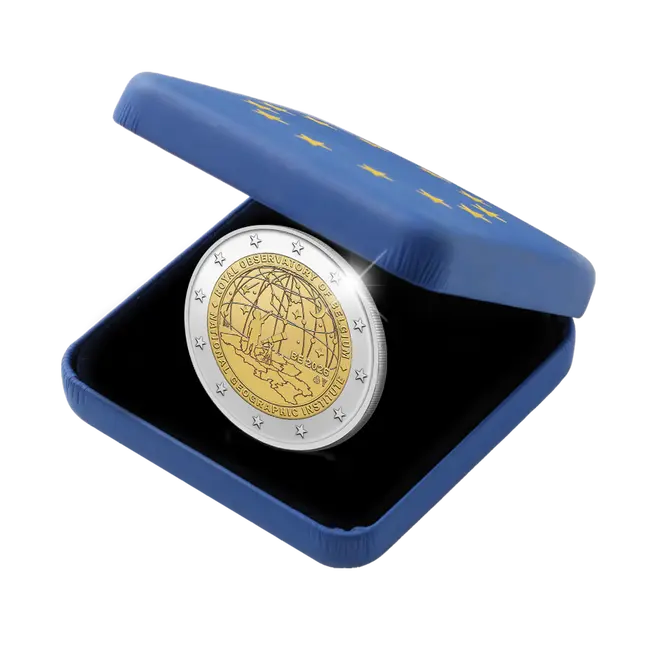
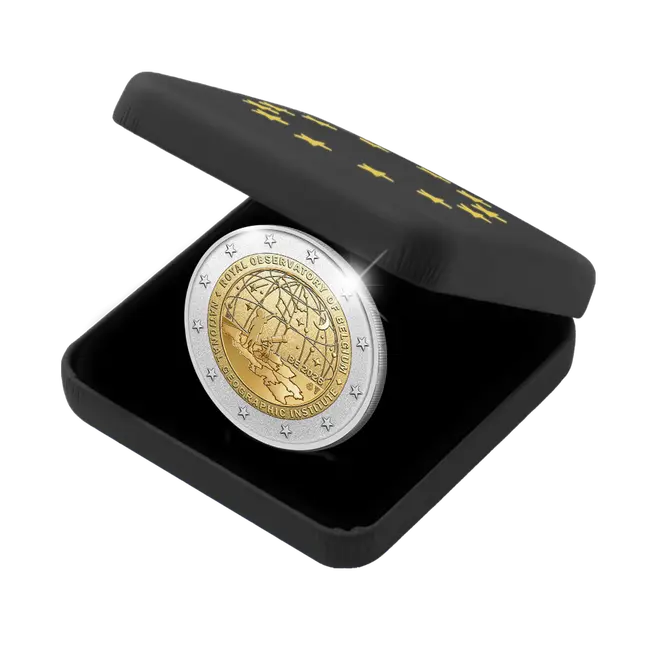
Designed by coin designer Iris Bruijns, the coin harmoniously brings together the worlds of astronomy and land surveying. The motif depicts the silhouette of a child pointing with fascination towards a star-filled night sky, tracing the striking outline of the Big Dipper, alongside a telescope mounted on a tripod. Both elements stand prominently atop a topographical map of Belgium, complete with its provincial borders. The interplay between the celestial view and the detailed map of the country symbolises, in a fittingly harmonious way, both the two centuries of astronomical research carried out by the Royal Observatory of Belgium and the fifty years of the National Geographic Institute. A fine, circular grid pattern representing the celestial sphere frames the scene along the upper edge. Along the inner rim of the coin, the English-language inscriptions "ROYAL OBSERVATORY OF BELGIUM" at the top and "NATIONAL GEOGRAPHIC INSTITUTE" at the bottom mark the occasions being commemorated. To the right of the motif appear the country code "BE," the year of issue "2026," the caduceus mark of the Dutch mint facility, and the mintmark of the currently serving Master of the Mint, Giovanni Van de Velde. The designer's initials, "IB," appear on the left. The twelve stars of the European flag complete the design along the outer ring.
The two institutions being honoured share a long and closely intertwined history within Belgium's scientific tradition. The Royal Observatory of Belgium was founded in 1826 on the initiative of Adolphe Quetelet and has spent two centuries advancing the study of the cosmos, seismology, and precise timekeeping. The National Geographic Institute (NGI), meanwhile, took on its present form only in 1976, succeeding the storied Military Geographic Institute. For the past 50 years, the Institute has been responsible for the official topographical mapping of the country, producing highly precise maps and providing modern geodata services that today serve as an indispensable foundation for infrastructure and research alike.
The coin was also officially issued today, Friday, 25 September 2026. As has become customary in Belgium, it was released exclusively in special collector packaging intended for the numismatic market. The total mintage comes to exactly 132,500 pieces, of which 125,000 were issued in Brilliant Uncirculated quality in the country's typical coincards, while a further 4,000 coins were struck in Proof quality and presented in a case, and 3,500 pieces were issued in Reverse Proof finish for collectors.
Source: Royal Belgian Mint