200 Years of the Royal Observatory of Belgium and 50 Years of the National Geographic Institute
 + Add to collection In collection ★ Wanted
 At a glance
| Country | Belgium |
|---|---|
| Year | 2026 |
| Issue date | 25 September 2026 |
| Coin type | Commemorative coin |
| Mintage | 132.500 (125.000 / 7.500) |
| Catalogue number | BE-26 G2 |
| Designer | Iris Bruijns |
| Rarity | €€€€€ what does this mean? |
| Edge lettering |  |
| Market value (approx.) | 14 € · guide price, uncirculated Unlock · for members |
Coin description
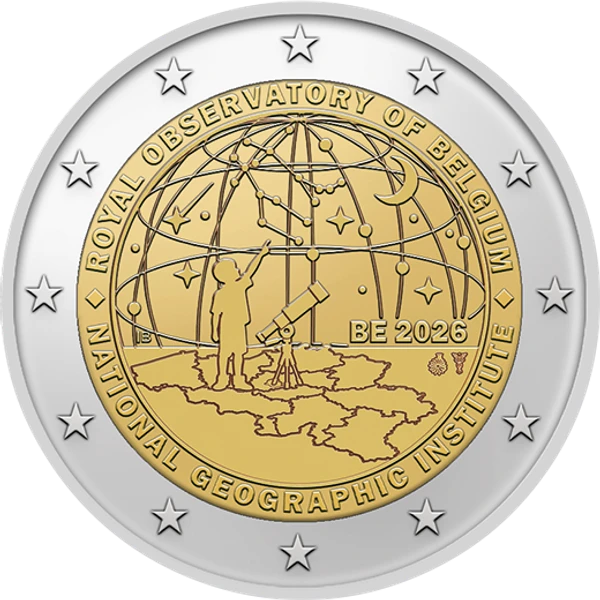
The design shows the silhouette of a child pointing with fascination into the star-studded night sky at the distinctive asterism of the Big Dipper, alongside a telescope mounted on a tripod, with both elements standing prominently on a topographical map of Belgium showing its provincial borders. A fine, circular grid structure representing the celestial sphere surrounds the scene in the upper area. Along the inner ring of the coin, the English-language occasions for issue read “ROYAL OBSERVATORY OF BELGIUM” at the top and “NATIONAL GEOGRAPHIC INSTITUTE” at the bottom. On the right of the design are the country code “BE” and the year of issue “2026”, along with the caduceus mark of the Dutch mint and the mint master’s mark of the serving mint master Giovanni Van de Velde. The designer’s initials “IB” appear on the left-hand side. The twelve stars of the European flag on the outer ring complete the design.
Further information on the topic
The Royal Observatory of Belgium in Uccle is among the oldest and scientifically most significant astronomical institutions in Europe. Founded in 1826 under King William I, it developed over the 19th and 20th centuries into a center for timekeeping, seismology, and astrophysics. Belgium played an outsized role in international scientific work: the observatory long coordinated the country's official time signal and supplied data for European seismology. Today it also conducts solar observation and analyzes fluctuations in the Earth's rotation — fields of research with global relevance.
The National Geographic Institute of Belgium, founded in 1976 out of the military cartography service, is the country's central authority for official topographic maps, geodesy, and spatial reference data. Its work forms the basis for urban planning, infrastructure, and digital geoinformation services in Belgium. In the European context, the institute contributes to cross-border geodata projects and EU initiatives to harmonize geographic information. In 2026, Belgium honors both institutions together: the observatory's 200-year history and the geographic institute's 50th anniversary.
Official issues of the coin
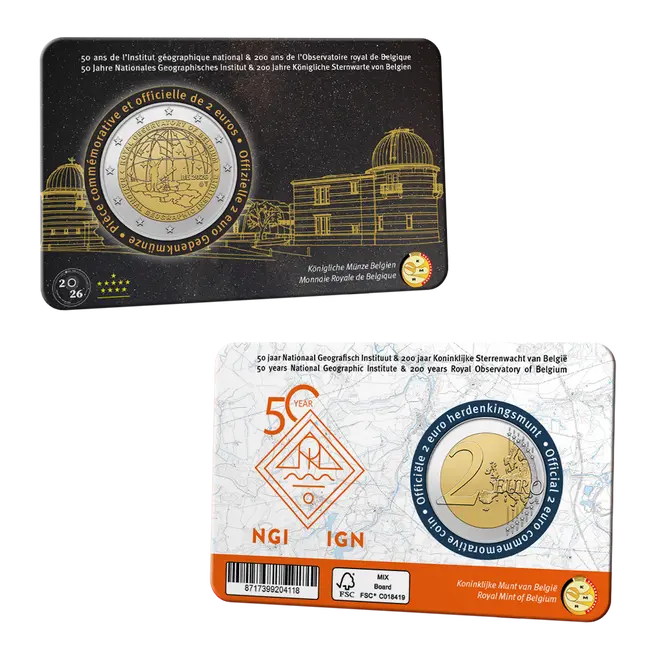 ©Image credit: Königliche Belgische Münze
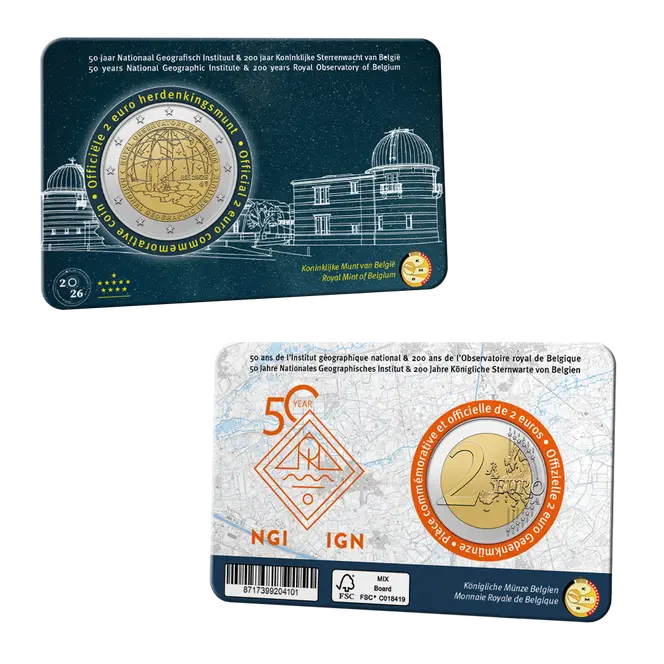 ©Image credit: Königliche Belgische Münze
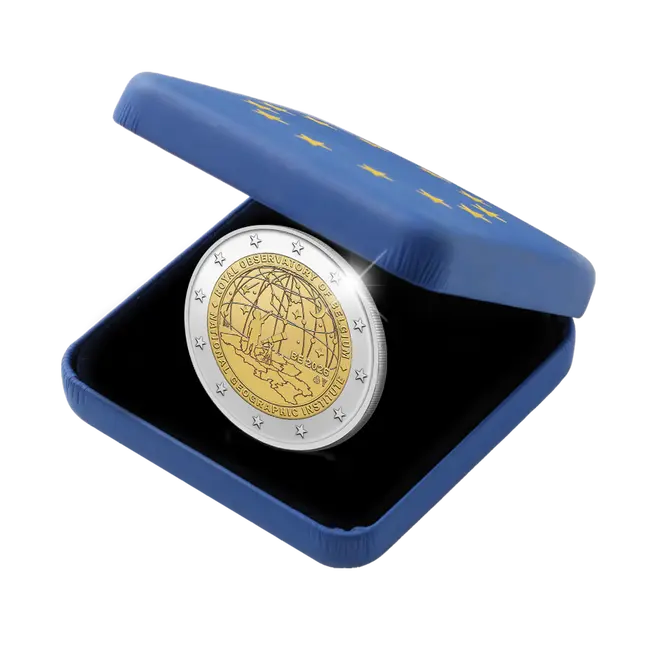 ©Image credit: Königliche Belgische Münze
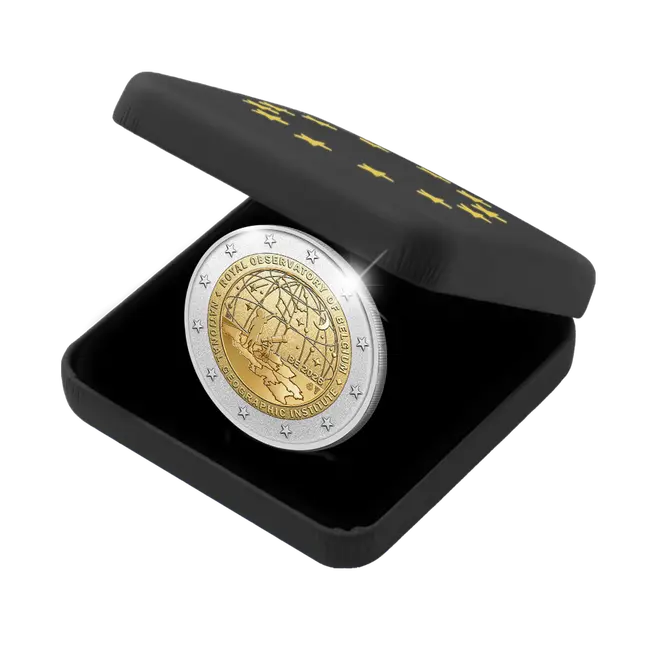 ©Image credit: Königliche Belgische Münze
Technical data
| Face value | 2 euro |
|---|---|
| Material | Bimetallic – outer ring: cupronickel; centre: three layers (nickel-brass / nickel / nickel-brass) |
| Weight | 8.5 g |
| Diameter | 25.75 mm |
| Thickness | 2.20 mm |