550th Anniversary of the Death of Donatello
 + Add to collection In collection ★ Wanted
 At a glance
| Country | San Marino |
|---|---|
| Year | 2016 |
| Issue date | 5 April 2016 |
| Coin type | Commemorative coin |
| Mintage | 87.800 (85.000 / 2.800) |
| Catalogue number | SM-16 G1 |
| Designer | Matt Bonaccorsi |
| Rarity | €€€€€ what does this mean? |
| Edge lettering |  |
| Market value (approx.) | 28 € · guide price, uncirculated Unlock · for members |
Coin description
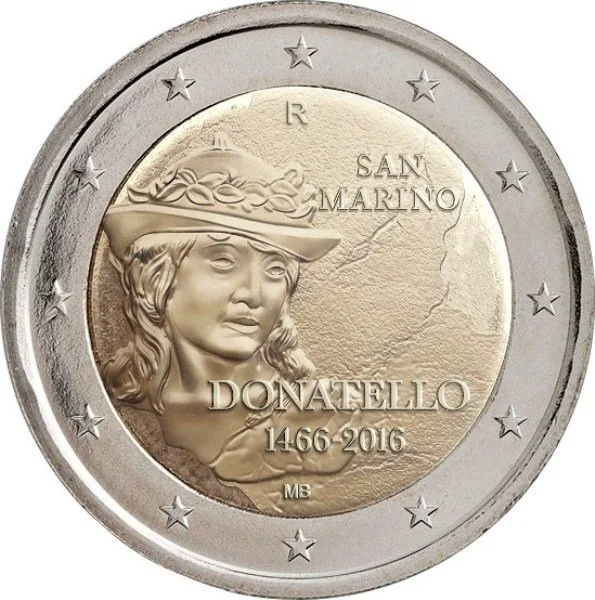
The head of David, taken from Donatello's bronze statue; the inscription "DONATELLO" and the dates "1466 – 2016"; the country name "SAN MARINO", the initials of designer Matt Bonaccorsi and the "R" mintmark.
Further information on the topic
In 15th-century Florence unfolded one of the most influential careers in European art history: Donato di Niccolò di Betto Bardi, known as Donatello, was born around 1386 in the city on the Arno and, as a sculptor, shaped the Renaissance like scarcely any other contemporary. His works - including the bronze David, the equestrian statue of Gattamelata in Padua, and the reliefs on the high altar of the Basilica of Sant'Antonio - broke decisively with medieval forms of expression. Donatello developed the schiacciato relief technique, worked masterfully in marble, bronze and wood, and created figures of a psychological immediacy not matched again for generations. His influence extended far beyond Tuscany and is regarded as foundational to the understanding of sculpture in Western art.
San Marino, the oldest republic in the world, lies geographically at the heart of central Italy, nestled in the hills of Emilia-Romagna near Rimini - a city where Donatello himself worked for years and carried out important commissions. This spatial and cultural proximity makes the small state's connection to the Florentine Renaissance especially plausible. Donatello died on 13 December 1466 in Florence, where he was buried. With its 2-euro commemorative coin of 2016, San Marino marks the 550th anniversary of the sculptor's death, placing at its centre an artist whose work remains, to this day, among the most closely studied testimonies of the early Renaissance in Italian and international museums.
Technical data
| Face value | 2 euro |
|---|---|
| Material | Bimetallic – outer ring: cupronickel; centre: three layers (nickel-brass / nickel / nickel-brass) |
| Weight | 8.5 g |
| Diameter | 25.75 mm |
| Thickness | 2.20 mm |