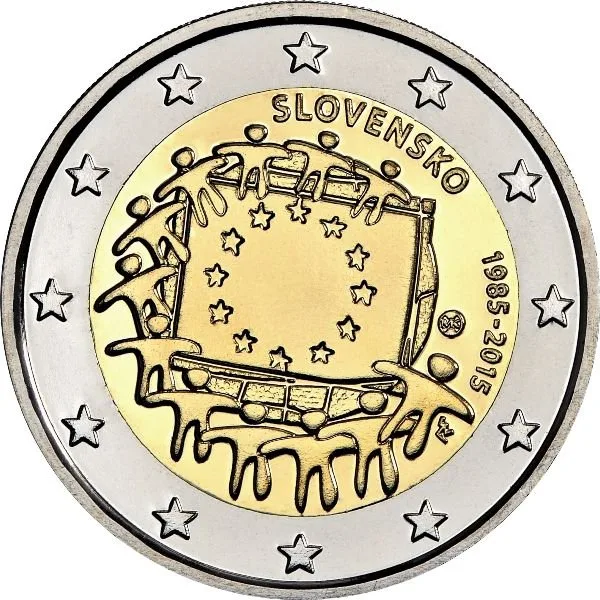
30 Years of the European Flag
 + Add to collection In collection ★ Wanted
 At a glance
| Country | Slovakia |
|---|---|
| Year | 2015 |
| Issue date | 24 September 2015 |
| Coin type | Commemorative coin |
| Mintage | 1.000.000 (8.000 / – ) |
| Catalogue number | SK-15 G1 |
| Designer | Georgios Stamatopoulos |
| Rarity | €€€€€ what does this mean? |
| Edge lettering |  |
| Market value (approx.) | 4 € · guide price, uncirculated Unlock · for members |
Coin description
The EU flag as a symbol bringing peoples and cultures together around shared ideals and visions for a better future. Twelve stars take on human form to welcome the birth of a new Europe. Along the upper right of the coin ring, the issuing state 'SLOVENSKO' and the years '1985–2015'. The mintmark of the Kremnica Mint (Mincovňa Kremnica), consisting of 'MK' between two die stamps, appears to the right between the flag and the dates. The initials of designer Georgios Stamatopoulos are shown at the lower right.
Note on the coin
Fourth joint issue of the European Union. All 19 eurozone states issued a coin with the same design on varying dates. The coins differ only in their inscriptions, which appear in the respective national language.
Further information on the topic
The European flag, with its twelve gold stars on a blue background, traces back to an initiative of the Council of Europe: in 1955, the Council adopted it as its own symbol to give visible expression to the idea of a united Europe. The number twelve did not represent a specific number of members but was regarded as a symbol of completeness and harmony — a choice deliberately meant to transcend time. The European Community, later the European Union, did not officially adopt the flag until 1985, creating a shared visual identity for all member states. In Slovakia, which joined the EU in 2004 and has used the euro as its currency since 2009, the flag stands for a political course that, after the end of the Warsaw Pact and the peaceful split from the Czech Republic in 1993, has consistently oriented the country westward.
The 30th anniversary of the flag's official adoption by the EU in 2015 gave all euro states occasion for a joint commemorative issue. Such European joint issues, in which all participating countries mint the same design, are rare within the euro coin programme and occur only for themes of Union-wide significance. In the decades since its introduction, the flag itself has spread far beyond institutional buildings and is today one of the world's best-known political symbols — one that stands for cross-border cooperation and the long process of European integration in which Slovakia has been an active participant for more than two decades.
Technical data
| Face value | 2 euro |
|---|---|
| Material | Bimetallic – outer ring: cupronickel; centre: three layers (nickel-brass / nickel / nickel-brass) |
| Weight | 8.5 g |
| Diameter | 25.75 mm |
| Thickness | 2.20 mm |
More 2-euro coins from Slovakia
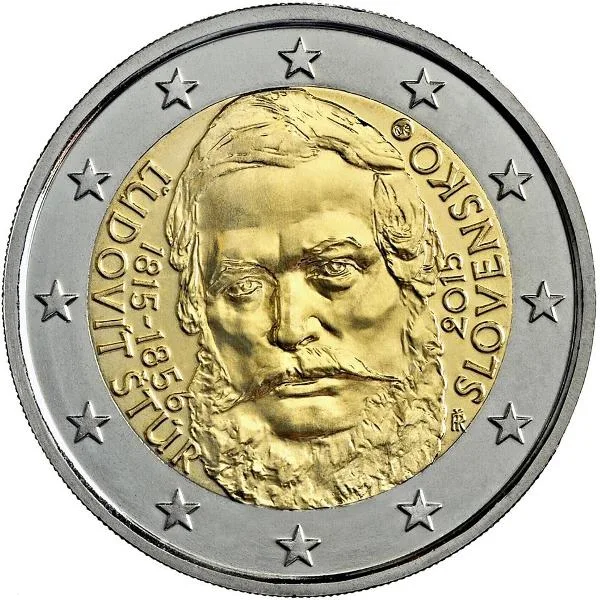
200th Birthday of Ľudovít Štúr
Commemorative coin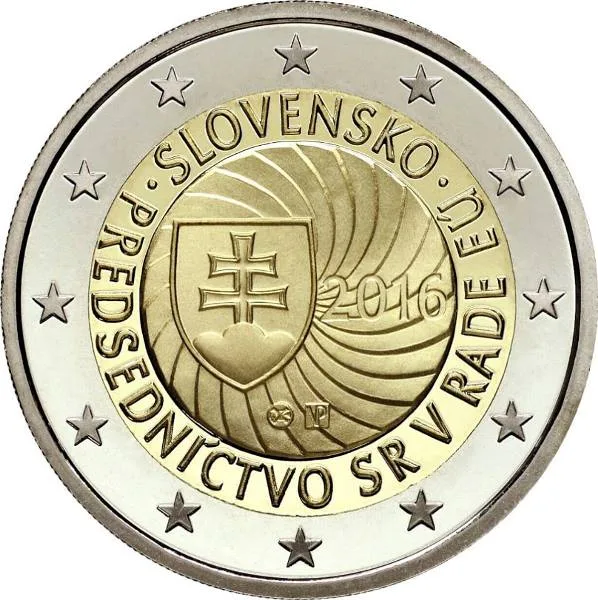
EU Council Presidency Slovakia 2016
Commemorative coin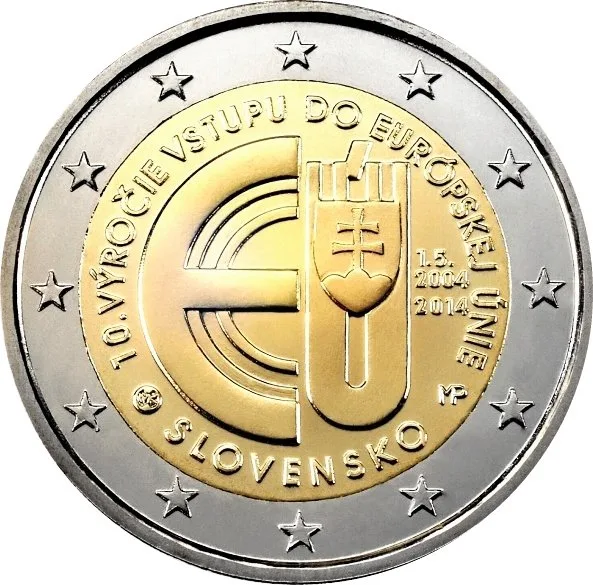
10 Years of Slovakia's EU Accession
Commemorative coin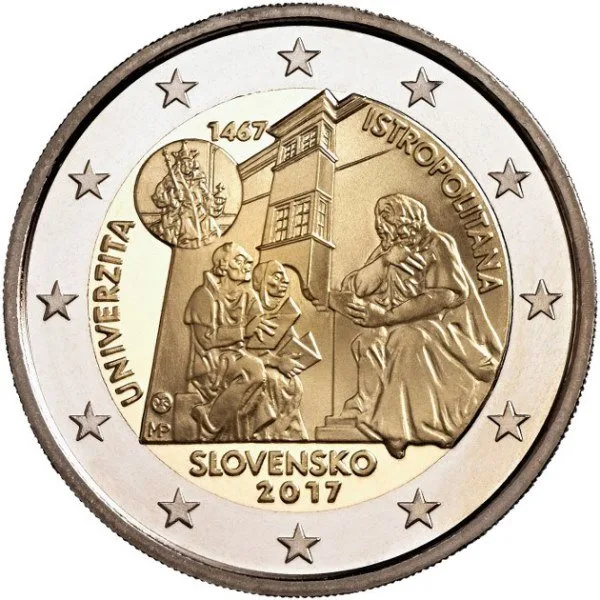
550th Anniversary of the Founding of the Universitas Istropolitana
Commemorative coin