200th Anniversary of the Death of Ludwig van Beethoven
 ©Image credit: Münze Österreich AG + Add to collection In collection ★ Wanted
 At a glance
| Country | Austria |
|---|---|
| Year | 2027 |
| Issue date | 2 December 2026 |
| Coin type | Commemorative coin |
| Mintage | ( – / 7.500) |
| Catalogue number | AT-27 G1 |
| Designer | not yet known |
| Rarity | €€€€€ what does this mean? |
| Edge lettering |  |
Coin description
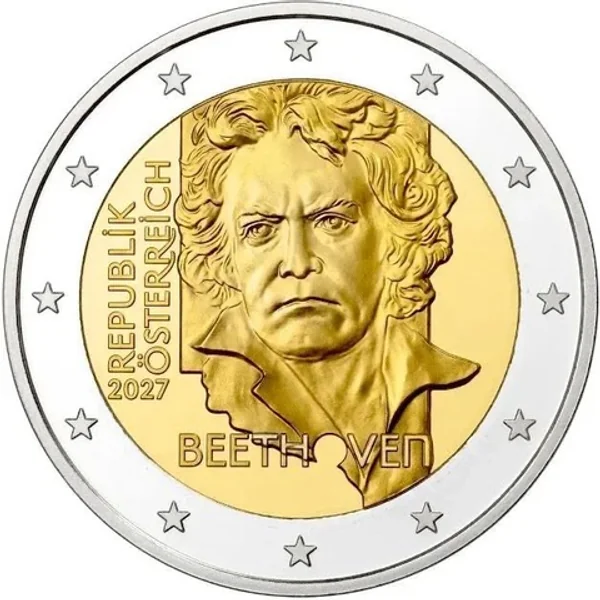
Portrait of Ludwig van Beethoven (1770–1827), the world-famous composer who spent much of his life and work in Vienna, shown in three-quarter profile. Along the left edge of the coin, the country name “REPUBLIK ÖSTERREICH” is engraved vertically, with the year “2027” beneath it. Directly below the portrait runs the artist’s name “BEETHOVEN”. The outer ring of the coin features the twelve stars of the European flag.
Further information on the topic
Ludwig van Beethoven was born in Bonn in December 1770 and remains one of the most significant composers in the history of Western music. In 1792 he settled permanently in Vienna, where he first studied under Joseph Haydn and quickly made his name as a virtuoso pianist and a strikingly original composer. His work marks the transition from the Viennese Classical era to Romanticism – Beethoven expanded the inherited forms of the symphony, sonata and string quartet and opened them to a hitherto unknown emotional and dramatic expression.
His most famous works include the nine symphonies, five piano concertos and 32 piano sonatas – among them the ‘Moonlight’ and the ‘Pathétique’ – as well as his only opera, ‘Fidelio’. From the late 1790s onwards Beethoven suffered from progressive hearing loss and was almost completely deaf in his final years; yet it was precisely in this period that some of his greatest masterpieces were created. The finale of his Ninth Symphony, with its choral setting of Schiller’s ‘Ode to Joy’, was adopted as the European Anthem by the Council of Europe in 1972 and today also serves as the official anthem of the European Union.
The year 2027 marks the 200th anniversary of Beethoven’s death – he died in Vienna on 26 March 1827. Austria is honouring this anniversary with its own 2-euro commemorative coin.
Technical data
| Face value | 2 euro |
|---|---|
| Material | Bimetallic – outer ring: cupronickel; centre: three layers (nickel-brass / nickel / nickel-brass) |
| Weight | 8.5 g |
| Diameter | 25.75 mm |
| Thickness | 2.20 mm |