200 Years of the Austrian National Bank
 + Add to collection In collection ★ Wanted
 At a glance
| Country | Austria |
|---|---|
| Year | 2016 |
| Issue date | 18 January 2016 |
| Coin type | Commemorative coin |
| Mintage | 16.000.000 (50.000 / 10.000) |
| Catalogue number | AT-16 G1 |
| Designer | Herbert Wähner |
| Rarity | €€€€€ what does this mean? |
| Edge lettering |  |
| Market value (approx.) | 4 € · guide price, uncirculated Unlock · for members |
Coin description
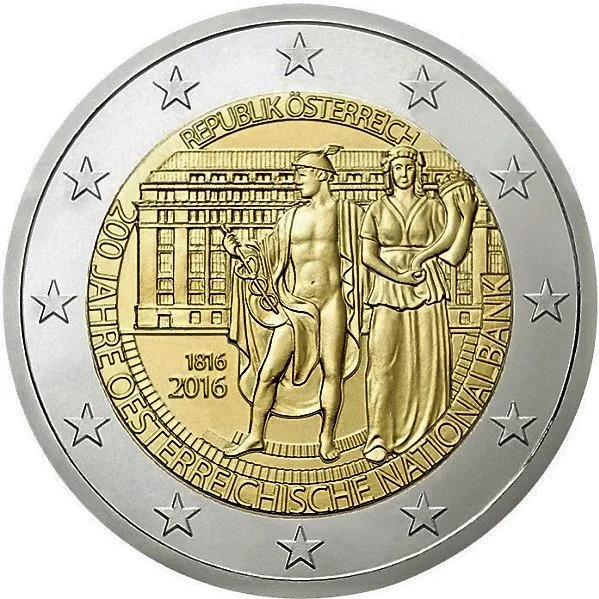
Two figures from Roman mythology, taken from the stone relief above the entrance of the OeNB's main building: on the left, Mercury, messenger of the gods and patron of merchants and trade; on the right, Fortuna, goddess of fortune and prosperity, holding a cornucopia. The main OeNB building extends in the background. Along the lower inner rim runs a band recalling the red-white-red pattern of the Austrian flag. The dates "1816" and "2016" mark the bank's founding year and its bicentenary. The inscriptions along the inner rim of the gold-coloured field read "Republik Österreich" and "200 Jahre Österreichische Nationalbank".
Further information on the topic
The Austrian National Bank is among the oldest central banks in the world. It was founded in 1816 by order of Emperor Francis I, after the Napoleonic Wars and repeated state bankruptcies had thrown state finances into disarray. From the outset, its task was to stabilise the currency and control the money supply in the Habsburg Monarchy. The headquarters building on Vienna's Otto-Wagner-Platz, completed in 1925, exemplifies the institution's aspirations: the neoclassical building, with its reliefs above the entrance, combines ancient symbolism with the self-image of an institution built on reliability and continuity. Mercury, patron of trade, and Fortuna, embodiment of prosperity and fate, still frame the entrance today.
Since Austria joined the eurozone in 1999, the OeNB has been part of the European System of Central Banks and shares responsibility, together with the European Central Bank, for monetary policy in the euro area. It is responsible for issuing euro banknotes in Austria, monitors financial market stability, and produces economic analyses and statistics. Its research division enjoys international recognition, particularly in Central and Eastern European studies. The 200th anniversary of the National Bank's founding in 2016 was an occasion to look back on two centuries of monetary-policy history in Austria — from stabilisation after the Napoleonic upheavals to integration into the European monetary union.
Technical data
| Face value | 2 euro |
|---|---|
| Material | Bimetallic – outer ring: cupronickel; centre: three layers (nickel-brass / nickel / nickel-brass) |
| Weight | 8.5 g |
| Diameter | 25.75 mm |
| Thickness | 2.20 mm |