500th Anniversary of the Death of Marko Marulić
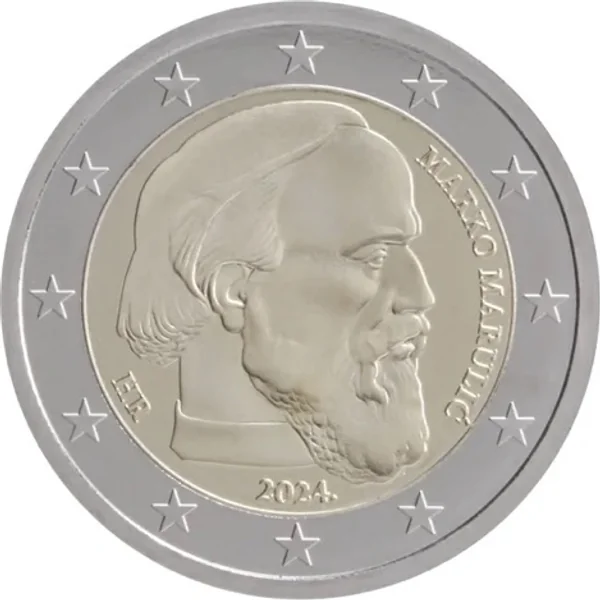 ©Image credit: Numismatische Sammlung der Deutschen Bundesbank + Add to collection In collection ★ Wanted
 At a glance
| Country | Croatia |
|---|---|
| Year | 2024 |
| Issue date | 15 October 2024 |
| Coin type | Commemorative coin |
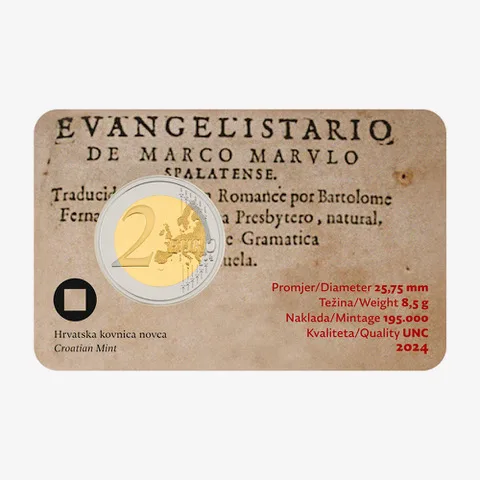
| Mintage | 200.000 (195.000 / 5.000) |
| Catalogue number | HR-24 G2 |
| Designer | Stjepan Divković |
| Rarity | €€€€€ what does this mean? |
| Edge lettering | 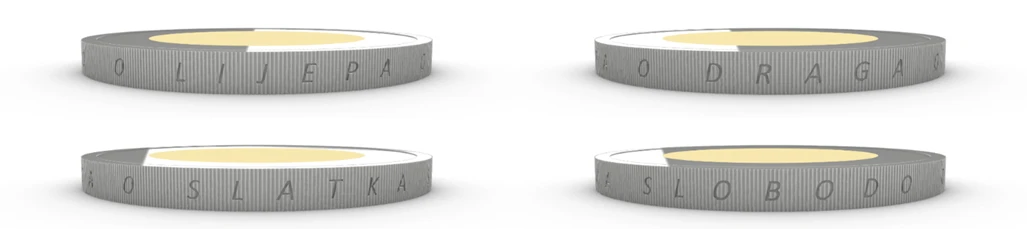 |
| Market value (approx.) | 11 € · guide price, uncirculated Unlock · for members |
Coin description
A portrait of Marko Marulić (1450–1524), Croatian writer, humanist, and scholar, shown in right-facing profile. Along the right edge the commemoration inscription "MARKO MARULIĆ"; along the lower left edge the country abbreviation "HR"; and at the bottom the year "2024".
Further information on the topic
In the late 15th century, when the Dalmatian coastal city of Split was under Venetian rule and the humanist ideas of the Italian Renaissance were spreading across the Adriatic to the northeast, the literary work of Marko Marulić took shape in this zone of transition. Born in Split in 1450, the writer and scholar combined the classical learning of humanism with the Croatian vernacular and the Christian thought of his time. His epic poem "Judita," written around 1501 and printed in Venice in 1521, is regarded as one of the earliest significant works of Croatian-language literature — a text that made the biblical story of Judith accessible in the language of ordinary Dalmatians.
Marulić, however, wrote not only in Croatian but also extensively in Latin, achieving influence far beyond the Dalmatian region. His Latin devotional work "De institutione bene vivendi per exempla sanctorum" went through numerous editions across Europe in the 16th century and was translated into several languages; Erasmus of Rotterdam is said to have held him in high regard. This dual body of work — vernacular and Latin, local and European at once — established his reputation as the father of Croatian literature. Croatia honoured him in 2024 on the 500th anniversary of his death with a 2-euro commemorative coin, recalling a humanist whose influence reached far beyond his home region.
Official issues of the coin
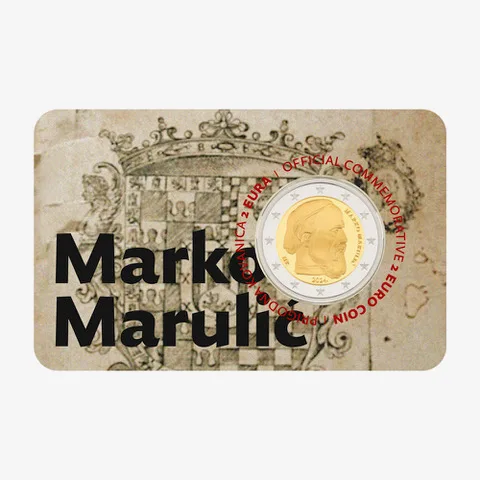 ©Image credit: Hrvatska kovnica novca
 ©Image credit: Hrvatska kovnica novca
 ©Image credit: Hrvatska kovnica novca
Technical data
| Face value | 2 euro |
|---|---|
| Material | Bimetallic – outer ring: cupronickel; centre: three layers (nickel-brass / nickel / nickel-brass) |
| Weight | 8.5 g |
| Diameter | 25.75 mm |
| Thickness | 2.20 mm |