
A monetary union without borders – the first common side
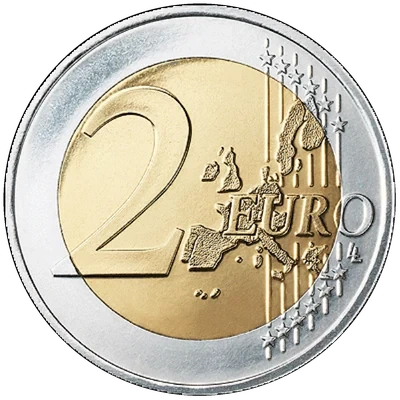
Profile
| In use | 2002 – 2007 |
|---|---|
| Designer | Luc Luycx (LL) |
| Face value | 2 euro |
| Weight | 8.5 g |
| Diameter | 25.75 mm |
| Thickness | 2.2 mm |
| Material | Outer ring copper-nickel · three-layer centre (nickel brass–nickel–nickel brass) |
| Edge | Finely milled, with incuse lettering that varies from country to country |
Background
The first common side of the euro coins showed the then European Union of fifteen member states – rendered as separate areas without national borders. The design put the participating states of the young monetary union in the foreground. This side, too, was created by the Belgian engraver Luc Luycx.
With the EU enlargement from 2004 this design no longer matched the growing community and was replaced in 2007 by the map of the entire continent. Some countries, however, continued to issue their circulation coins with the old common side for a while – in 2007 including Italy, Austria, Portugal, San Marino and the Vatican. The technical features of the coin – weight, diameter, material and edge lettering – remained unchanged in the switch; only the map motif was altered.
Countries still issuing the old common side in 2007
These countries also switched to the new map of Europe in 2008 – by 2008 all euro countries had changed the common side.