Saarland
 + Add to collection In collection ★ Wanted
 At a glance
| Country | Germany |
|---|---|
| Year | 2009 |
| Issue date | 6 February 2009 |
| Coin type | Commemorative coin |
| Mintage | varies by year & mint – see table below ↓ |
| Catalogue number | DE-09 G2 |
| Designer | Friedrich Brenner |
| Rarity | €€€€€ what does this mean? |
| Edge lettering |  |
| Market value (approx.) | 3 € · guide price, uncirculated Unlock · for members |
Coin description
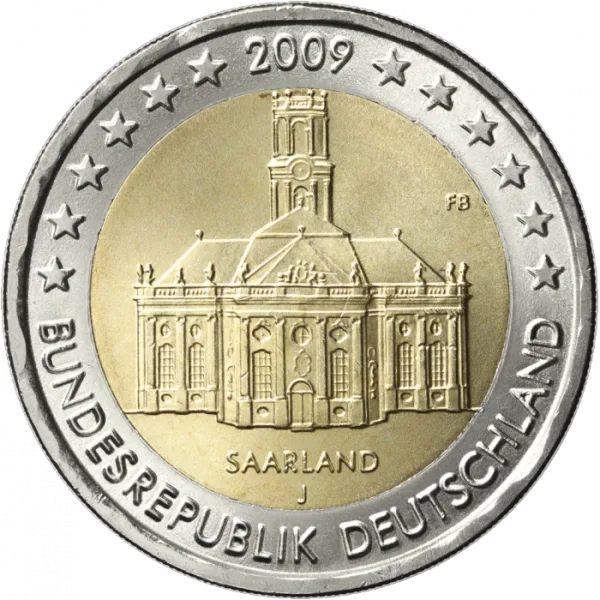
The Ludwigskirche in the state capital Saarbrücken. Below the building: the name of the federal state 'SAARLAND' and the relevant mintmark — 'A', 'D', 'F', 'G' or 'J'. To the right: the designer's initials 'FB' (Friedrich Brenner). The outer ring bears the name of the issuing state 'BUNDESREPUBLIK DEUTSCHLAND' along the bottom, the year '2009' at the top, and twelve EU stars between them.
Further information on the topic
The Saarland is Germany's smallest area-based federal state and at the same time one with the most turbulent political history of the 20th century. Placed under League of Nations mandate after the First World War and economically tied to France, its population voted in a 1935 referendum to return to the German Reich. After the Second World War came another period of separation: as a French protectorate between 1947 and 1956, the Saarland had its own constitution, its own currency, and even competed with its own team at the Olympic Games. Only after the 1955 referendum did it politically join the Federal Republic — economic integration followed in 1959. Saarbrücken, the state capital, became the central administrative and cultural city of the young federal state and today still bears the marks of this fractured history in its architecture and cityscape.
Economically, the Saarland was shaped for decades by coal mining and the steel industry — sectors that brought the region growth but also led it into the structural crisis of the late 20th century. The decline of the mines and steelworks from the 1970s onward forced a profound transformation that continues to this day. At the same time, close cultural and geographic ties with France and Luxembourg — the Saarland borders both countries — have remained a defining feature of the region. Saarland University and institutions such as the German Research Center for Artificial Intelligence (DFKI) in Saarbrücken represent the effort to reposition the region as a hub of knowledge. In 2009, Germany dedicated a 2-euro commemorative coin to the Saarland as part of the German Federal States series.
Official announcement (EU Official Journal): ABl. C 31 vom 7.2.2009, S. 5 (2009/C 31/06)
Mintages by mint
| Mint | Mintage |
|---|---|
| A | 6.000.000 (105.000 / 100.000) |
| D | 6.300.000 (105.000 / 100.000) |
| F | 7.200.000 (105.000 / 100.000) |
| G | 4.200.000 (105.000 / 100.000) |
| J | 6.300.000 (105.000 / 100.000) |
Technical data
| Face value | 2 euro |
|---|---|
| Material | Bimetallic – outer ring: cupronickel; centre: three layers (nickel-brass / nickel / nickel-brass) |
| Weight | 8.5 g |
| Diameter | 25.75 mm |
| Thickness | 2.20 mm |