2004 Olympic Games in Athens
 + Add to collection In collection ★ Wanted
 At a glance
| Country | Greece |
|---|---|
| Year | 2004 |
| Issue date | 12 May 2004 |
| Coin type | Commemorative coin |
| Mintage | 34.500.000 (500.000 / – ) |
| Catalogue number | GR-04 G1 |
| Designer | Panagiotis Gravvalos |
| Rarity | €€€€€ what does this mean? |
| Edge lettering |  |
| Market value (approx.) | 4 € · guide price, uncirculated Unlock · for members |
Coin description
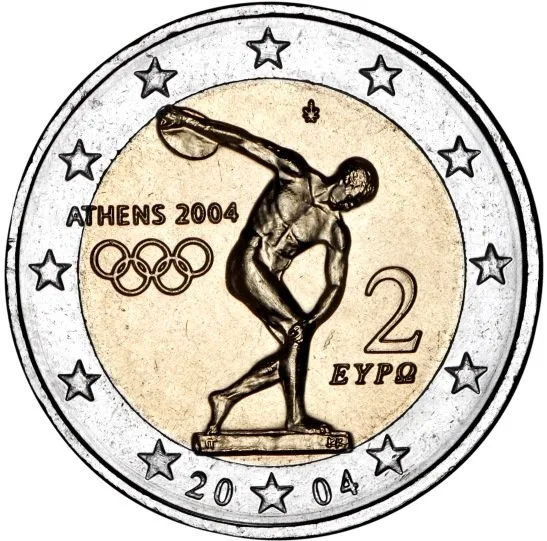
An ancient statue of a discus thrower encircled by the twelve stars of the European Union. The statue's base partially overlaps the coin's outer ring. To the left is the Athens 2004 Olympic logo with the five Olympic rings; to the right, the numeral "2" and the word "ΕΥΡΩ" stacked vertically. Beside the middle star at the bottom, the mintage year appears as two separate groups: 20*04; above the athlete's head at upper left is the mintmark.
Further information on the topic
Athens is the birthplace of the ancient Olympic Games. As early as 776 BC, the first recorded competitions took place in Olympia, bringing together athletes from the Greek city-states every four years. The discus throw was a fixed part of the ancient pentathlon and was seen as an expression of physical perfection. The competitions stood under the protection of Zeus and had a religious character; for the duration of the Games, a truce was observed throughout Greece. With the Christianisation of the Roman Empire, the Games were banned in 393 AD by Emperor Theodosius I - the Olympic idea lay dormant for some 1,500 years before the French educator Pierre de Coubertin revived it at the close of the 19th century.
The revival of the Olympic Games took place in 1896 exactly where it had all begun: in Athens. Greece hosted the first Games of the modern era, welcoming athletes from thirteen nations. More than a century later, the Games returned to Athens a second time: the 2004 Summer Olympics were once again held in the Greek capital, symbolically closing the circle. For Greece, this was more than a sporting event - it was a return to its own roots. To mark the occasion, Greece issued a 2-euro commemorative coin in 2004, honouring this historic convergence of ancient heritage and Olympic present.
Official issues of the coin
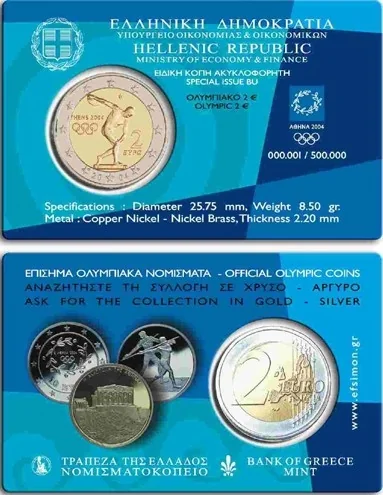 ©Image credit: Νομισματοκοπείο - IETA
Technical data
| Face value | 2 euro |
|---|---|
| Material | Bimetallic – outer ring: cupronickel; centre: three layers (nickel-brass / nickel / nickel-brass) |
| Weight | 8.5 g |
| Diameter | 25.75 mm |
| Thickness | 2.20 mm |