30 Years of the European Flag
 + Add to collection In collection ★ Wanted
 At a glance
| Country | Spain |
|---|---|
| Year | 2015 |
| Issue date | 1 December 2015 |
| Coin type | Commemorative coin |
| Mintage | 4.300.000 ( – / 10.000) |
| Catalogue number | ES-15 G2 |
| Designer | Georgios Stamatopoulos |
| Rarity | €€€€€ what does this mean? |
| Edge lettering |  |
| Market value (approx.) | 4 € · guide price, uncirculated Unlock · for members |
Coin description
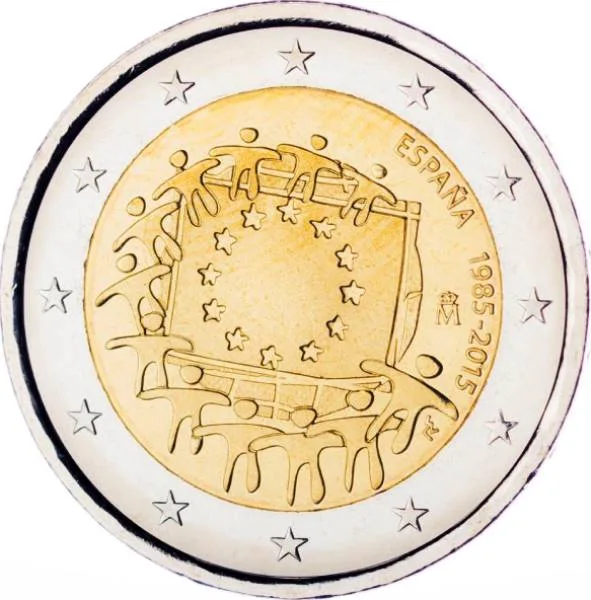
The EU flag as a symbol bringing peoples and cultures together around shared ideals and visions for a better future. Twelve stars take on human form to welcome the birth of a new Europe. Along the upper right of the coin ring, the issuing state 'ESPAÑA' and the years '1985–2015'. The mintmark appears to the right between the flag and the dates. The initials of designer Georgios Stamatopoulos appear at the lower right.
Note on the coin
Fourth joint issue of the European Union. All 19 eurozone states are issuing a coin with the same design on varying dates. The coins differ only in their inscriptions, which appear in the respective national language.
Further information on the topic
On 29 May 1986, the Council of Europe decided to formally adopt the blue banner with twelve gold stars, first used in 1955, as the symbol of a united Europe. The number twelve never represented the number of members, but symbolises completeness and unity — a concept deeply rooted in many European cultures. With Spain's accession to the European Community on 1 January 1986, the country became part of the project the flag was meant to embody: an economically and politically interconnected community of states built on cooperation after decades of conflict. For Spain, this step also marked the end of an isolation that had kept the country, under the Franco dictatorship, largely apart from the Western European integration process.
Since its adoption by the European Community, the European flag has undergone a remarkable transformation: from a symbol of the Council of Europe, it became the most widely recognised symbol of supranational politics in the world. It marks EU institutions, border crossings, vehicle plates, and identity documents across 27 member states — including Spain, today one of the eurozone's largest economies. To mark the 30th anniversary of the European flag's introduction, all euro states simultaneously issued a joint 2-euro commemorative coin in 2015, commemorating this shared symbol.
Technical data
| Face value | 2 euro |
|---|---|
| Material | Bimetallic – outer ring: cupronickel; centre: three layers (nickel-brass / nickel / nickel-brass) |
| Weight | 8.5 g |
| Diameter | 25.75 mm |
| Thickness | 2.20 mm |
More 2-euro coins from Spain
King Felipe VI
Circulation coin
UNESCO World Heritage Site – Cave of Altamira and Palaeolithic Cave Art
Commemorative coin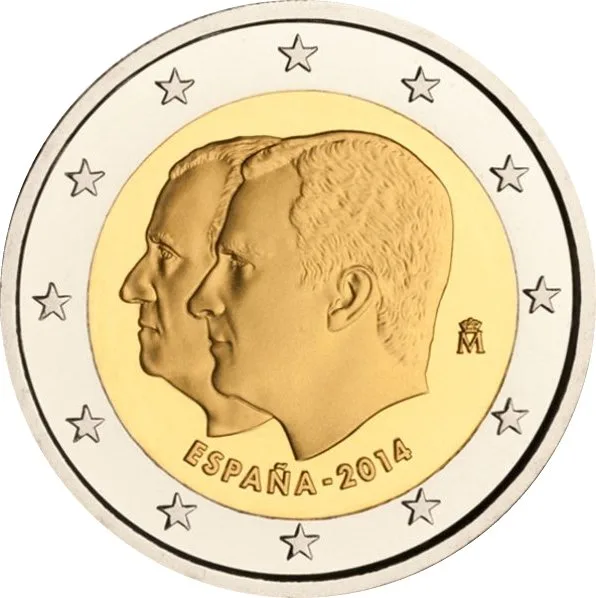
Proclamation of King Felipe VI
Commemorative coin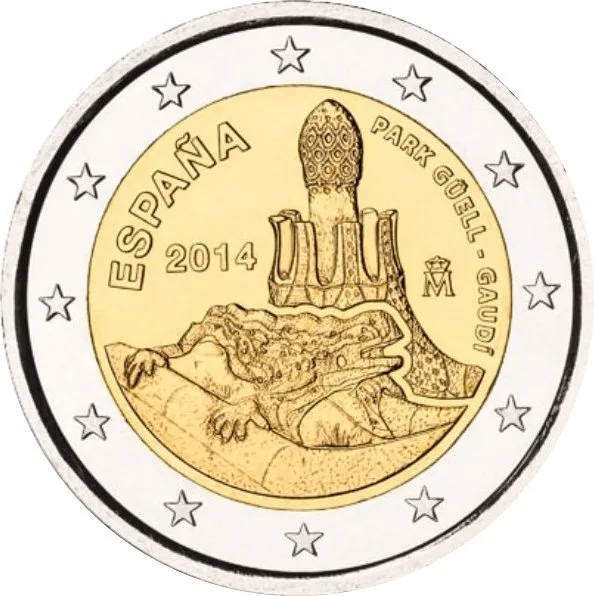
UNESCO World Heritage Site – Works of Antoni Gaudí and Park Güell
Commemorative coin