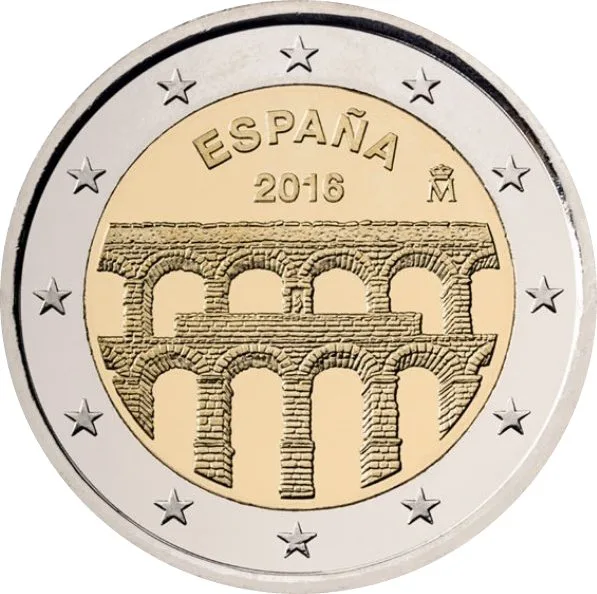
UNESCO World Heritage Site – Aqueduct of Segovia
 + Add to collection In collection ★ Wanted
 At a glance
| Country | Spain |
|---|---|
| Year | 2016 |
| Issue date | 5 February 2016 |
| Coin type | Commemorative coin |
| Mintage | 3.400.000 (75.148 / 11.040) |
| Catalogue number | ES-16 G1 |
| Designer | Alfonso Morales Múñoz |
| Rarity | €€€€€ what does this mean? |
| Edge lettering |  |
| Market value (approx.) | 4 € · guide price, uncirculated Unlock · for members |
Coin description
The Roman aqueduct of Segovia; the state name 'ESPAÑA', the year '2016', and the mintmark.
Further information on the topic
The Aqueduct of Segovia is one of the most impressive surviving examples of Roman engineering in Europe. The Castilian city of Segovia, located about 90 kilometres northwest of Madrid, owes not only its historic skyline to the structure but also its reputation as one of the most significant ancient sites on the Iberian Peninsula. Built probably in the 1st or early 2nd century AD, the aqueduct supplied the city with water from the Sierra de Guadarrama for centuries — a hydraulic feat achieved without mortar or binding material, relying solely on the precise fit of thousands of granite blocks. The structure was not merely infrastructure but a symbol of Roman order and administrative power in the province of Hispania.
Reaching a height of up to 28 metres in the old town, the aqueduct is an extraordinary example of Roman arch construction: around 167 arches on two levels span the city valley, largely in their original condition. In 1985, the entire old town of Segovia, together with the aqueduct, was recognised by UNESCO as a World Heritage Site — a protected status covering both the Roman legacy and the medieval city centre with its Alcázar and cathedral. Spain has issued regular editions of its long-running UNESCO World Heritage coin series since 2010; the coin minted in 2016 places the Aqueduct of Segovia within this series of outstanding national cultural monuments, drawing attention to one of the oldest still-functional infrastructure works of the Roman world.
Technical data
| Face value | 2 euro |
|---|---|
| Material | Bimetallic – outer ring: cupronickel; centre: three layers (nickel-brass / nickel / nickel-brass) |
| Weight | 8.5 g |
| Diameter | 25.75 mm |
| Thickness | 2.20 mm |
More 2-euro coins from Spain
King Felipe VI
Circulation coin
UNESCO World Heritage Site – Monuments of Oviedo and the Kingdom of Asturias
Commemorative coin
30 Years of the European Flag
Commemorative coin
UNESCO World Heritage Site – Cave of Altamira and Palaeolithic Cave Art
Commemorative coin