200th Birthday of Giuseppe Verdi
 + Add to collection In collection ★ Wanted
 At a glance
| Country | Italy |
|---|---|
| Year | 2013 |
| Issue date | 20 May 2013 |
| Coin type | Commemorative coin |
| Mintage | 10.000.000 (22.000 / 2.820) |
| Catalogue number | IT-13 G1 |
| Designer | Maria Carmela Colaneri |
| Rarity | €€€€€ what does this mean? |
| Edge lettering |  |
| Market value (approx.) | 4 € · guide price, uncirculated Unlock · for members |
Coin description
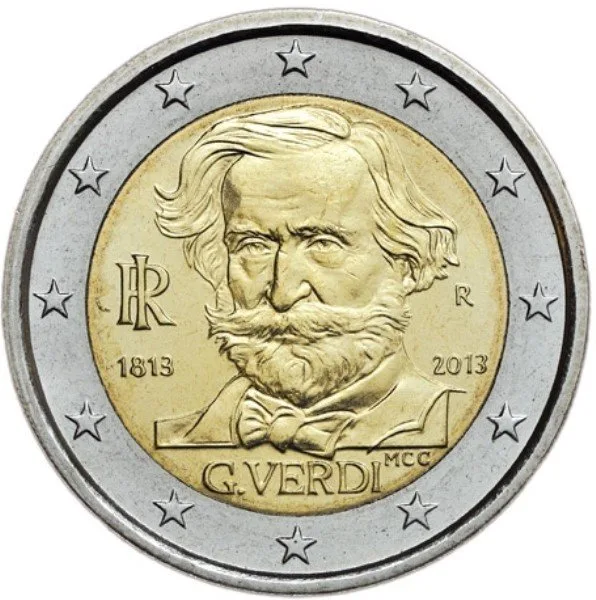
Three-quarter profile bust of Giuseppe Verdi, facing left; to the left, the overlapping letters of the Italian Republic monogram "RI" with the year "1813" below; to the right, the "R" mintmark of the Rome Mint, the year "2013", and the initials MCC (engraver Maria Carmela Colaneri), along with the name G. VERDI.
Further information on the topic
Giuseppe Verdi was born on 10 October 1813 in the village of Le Roncole near Busseto, then part of the Duchy of Parma — a region that would become part of the unified Kingdom of Italy just a few decades later. His path into music led through church service in Busseto and a rejected application to the Milan Conservatory to private study, before he made his debut in 1839 with the premiere of "Oberto" at La Scala in Milan. What followed was one of the most influential composing careers of the 19th century: with works such as "Nabucco" (1842), "Rigoletto" (1851), "La Traviata" (1853) and "Aida" (1871), Verdi fundamentally shaped the development of Italian opera. His music combined dramatic directness with melodic intensity and appealed to a broad audience — from folk-style songs to complex psychological character studies. It is historically documented, and part of Italy's collective memory, that individual choruses from "Nabucco", above all "Va, pensiero", were heard during the Risorgimento as unofficial anthems of the national movement.
Verdi was not only a composer but also a political figure of his time: during the Risorgimento, his name was read as an acronym for "Vittorio Emanuele Re D'Italia", and in 1861 he sat as a deputy for Busseto in the first all-Italian parliament. Late in life he created two of the most demanding works in the operatic repertoire — "Otello" (1887) and "Falstaff" (1893) — with librettos by Arrigo Boito after Shakespeare. Verdi died on 27 January 1901 in Milan; reports say his funeral drew hundreds of thousands onto the streets. Italy honoured the 200th anniversary of the birth of its greatest opera composer in 2013 with a 2-euro commemorative coin.
Technical data
| Face value | 2 euro |
|---|---|
| Material | Bimetallic – outer ring: cupronickel; centre: three layers (nickel-brass / nickel / nickel-brass) |
| Weight | 8.5 g |
| Diameter | 25.75 mm |
| Thickness | 2.20 mm |
More 2-euro coins from Italy
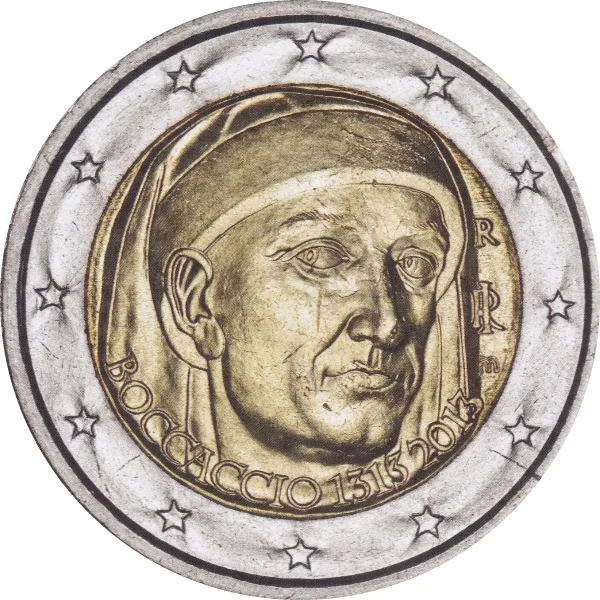
700th Birthday of Giovanni Boccaccio
Commemorative coin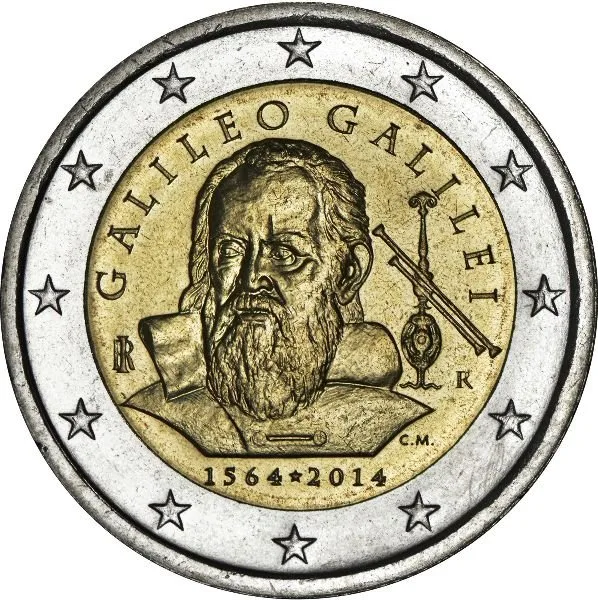
450th Birthday of Galileo Galilei
Commemorative coin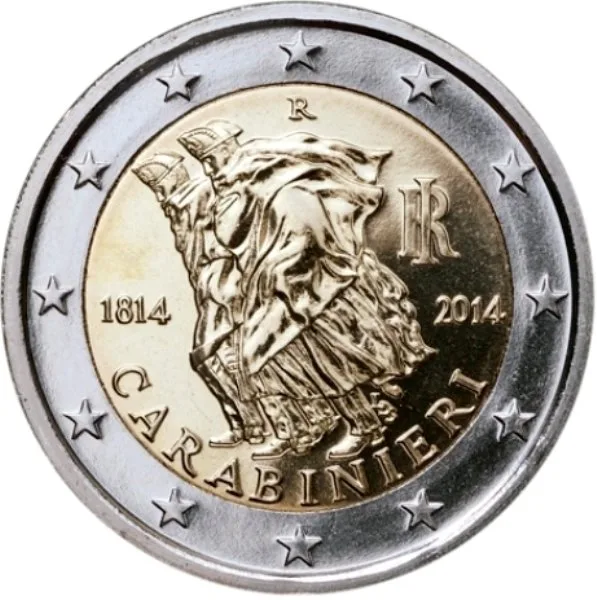
200 Years of the Carabinieri
Commemorative coin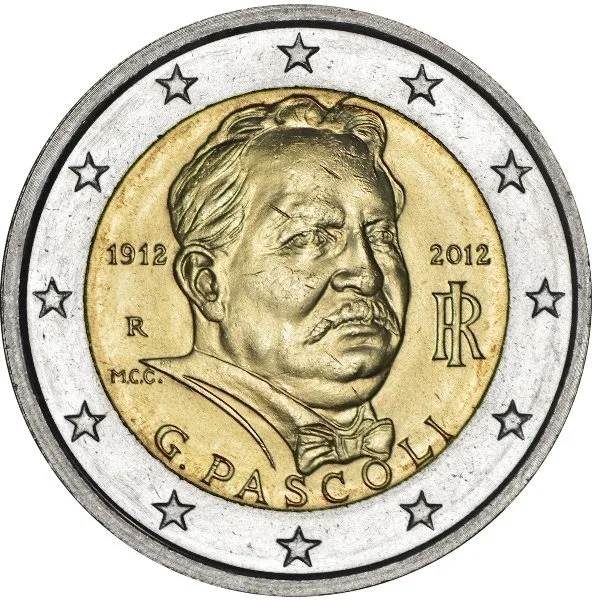
100th Anniversary of the Death of Giovanni Pascoli
Commemorative coin